

LIQUIDATIONS
How much was closed out by force
Positions the exchange closed when the collateral behind them ran out, across every exchange we record, by side and by size.
Forced closures across 9 exchanges
Recorded on 5 of the 9 exchanges we cover; the rest publish no reading of this kind. This reading has been complete since 2026-09-07; the 47 earlier days are not published, because a total that climbs as exchanges arrive is not a market move.
Right now
61.5% of it was people betting on a fall
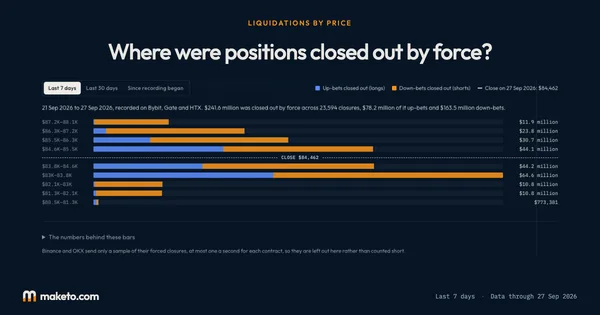
$25.0 million of up-bets and $39.8 million of down-bets were closed out. Closing a position that was betting on a rise means selling, so a wave of them pushes the price the way it was already going. That is why a large day here usually sits at the end of a sharp move rather than at the start of one.
How big was that against the money at stake?as of 20 Oct 2026
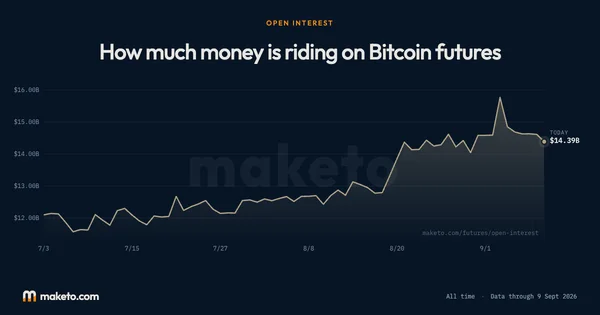
0.2% of the open bets. $64.8 million was closed out against $26.11 billion riding on futures. Read as a share it is usually small, and the days worth noticing are the ones where it is not. The two figures cover different numbers of exchanges, which the coverage lines under each of them give.
What were the biggest ones this week?
| Exchange | Which way it was betting | How big | Where it traded |
|---|---|---|---|
| Binance | an up-bet | $12.0 million | $80,209 |
| Binance | a down-bet | $12.0 million | $83,276 |
| Binance | an up-bet | $11.7 million | $80,642 |
| Binance | an up-bet | $10.3 million | $81,165 |
| Binance | an up-bet | $8.2 million | $80,827 |
| Binance | an up-bet | $7.2 million | $81,000 |
| Bybit | an up-bet | $6.5 million | not published as a traded price |
| Binance | a down-bet | $6.2 million | $82,845 |
The largest single closures recorded over the past week, biggest first, which is a wider window than the daily readings above and is why the top row here can be several times the largest of any one day. The side named is the position that was closed, not the order that closed it. Some exchanges publish the level their own system used to close a position rather than the price it traded at. Those rows leave the price out, because printing it would read as a trade that never happened.
The numbers
behind the chart
What does the current reading show?
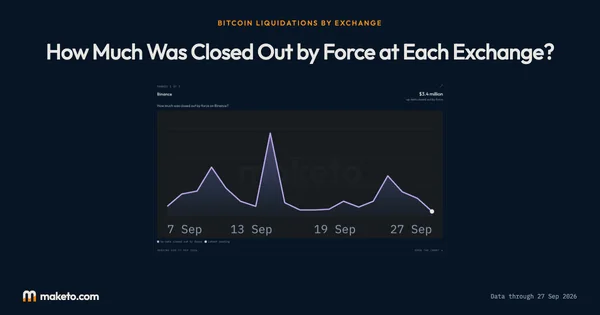
Forced closures: the latest reading is $64.8 million, on . The highest reading since is $351.4 million on ; the lowest is $1.8 million on .
A contract here is one exchange's version of the bet. The dollar-settled and the coin-settled versions count separately, so an exchange can carry more than one. Two sets of exchanges are published side by side and never spliced into one line: the widest set the site follows, and the three with the longest record. Joining them would draw a step change on the morning an exchange arrived and label it a market move. These stopped trading or paused, and are no longer counted: BitMEX on 16 Sep 2026, one Bitget contract on 17 Sep 2026 and Coinbase International on 1 Oct 2026.
What are the latest, highest and lowest readings?
| Measure | Latest | Highest | Lowest |
|---|---|---|---|
| Forced closures | $64.8 million | $351.4 million | $1.8 million |
How do the readings compare with earlier dates?
| Reference date | Forced closures |
|---|---|
| 1 month ago | $55.7 million |
What was the reading at each month’s end?
| Reading date | Forced closures |
|---|---|
| $69.5 million |
Understanding
Bitcoin Liquidations
Where it stands today
$64.8 million of positions were closed out by force in a day as of .
$25.0 million of that was people betting on a rise as of .
$39.8 million of that was people betting on a fall as of .
A leveraged position is backed by collateral. When the price moves far enough against it, the exchange closes the position rather than waiting, and that forced close is a liquidation. Because closing a long position means selling, a wave of them pushes the price the way it was already going, which is why a large day here often sits at the end of a sharp move rather than at the start of one.
The side named is the position that was closed, not the order that closed it. Up-bets closed out means people who were betting on a rise; down-bets closed out means the other side.
These totals describe what was recorded, never the whole market. One exchange publishes at most one closure per second per contract, so its figure is a floor rather than a count, and several exchanges publish no record of forced closures at all. The coverage line under every reading says how many are behind it, and the honest way to read the number is as a comparison with other days on the same basis rather than as a total.
Two views of the same number run side by side on this page and are never joined into one line. The wider one covers every exchange here and is the more complete picture; it is also the younger, because it only begins on the first day all of them reported. The narrower one is three exchanges with months of history behind it. A single line spliced from both would draw a step upward on the morning the other exchanges arrived and it would look exactly like a market move.
Source: Read from the exchanges' own published contract records, 9 of them, once a day. A contract here is one exchange's version of the bet. The dollar-settled and the coin-settled versions count separately, so an exchange can carry more than one. Reading for .