

FUNDING RATE
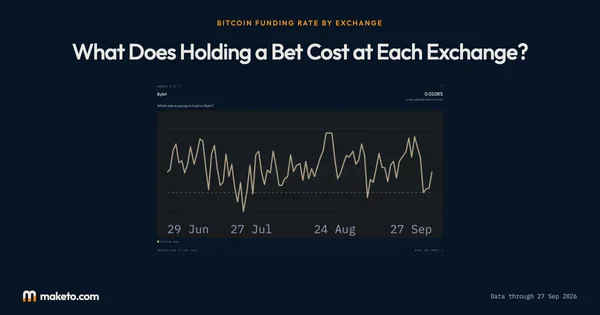
Which side is paying to hold its position
The fee that keeps perpetual contracts tied to the spot price, weighted by how much money each exchange is carrying.
Funding rate across 3 exchanges
Recorded on all 6 contracts, across 3 exchanges.
Right now
The people betting on a rise are paying
Across the last settlement the rate came to 0.0077%. A positive rate means the contract is trading above the spot price and the up side is paying the down side to keep its position open. It is charged several times a day, so it adds up on a position held for a week.
Do the exchanges agree?as of 20 Oct 2026
0.0083% between the highest and the lowest. This is the gap between the exchange charging the most and the one charging the least at the same settlement. It is worth reading beside the average rather than instead of it: a market where every exchange quotes the same rate and one where they quote opposite signs can average to the same number, and only the gap tells them apart.
Recorded on all 16 contracts, across 9 exchanges. 3 of them did not report on the latest day, so the reading is short of its usual coverage. This reading has been complete since 2026-09-08; the 48 earlier days are not published, because a total that climbs as exchanges arrive is not a market move.
The numbers
behind the chart
What does the current reading show?
Funding rate: the latest reading is 0.0077%, on . The highest reading since is 0.0100% on ; the lowest is -0.0003% on .
A contract here is one exchange's version of the bet. The dollar-settled and the coin-settled versions count separately, so an exchange can carry more than one. Two sets of exchanges are published side by side and never spliced into one line: the widest set the site follows, and the three with the longest record. Joining them would draw a step change on the morning an exchange arrived and label it a market move. These stopped trading or paused, and are no longer counted: BitMEX on 16 Sep 2026, one Bitget contract on 17 Sep 2026 and Coinbase International on 1 Oct 2026.
What are the latest, highest and lowest readings?
| Measure | Latest | Highest | Lowest |
|---|---|---|---|
| Funding rate | 0.0077% | 0.0100% | -0.0003% |
How do the readings compare with earlier dates?
| Reference date | Funding rate |
|---|---|
| 1 month ago | 0.0087% |
What was the reading at each month’s end?
| Reading date | Funding rate |
|---|---|
| 0.0047% | |
| 0.0085% | |
| 0.0076% |
Understanding
Bitcoin Perpetual Funding Rate
Where it stands today
Holding a position costs 0.0077% a settlement as of .
The highest and lowest exchange rates sit 0.0083% apart as of .
Almost all of this trading is in perpetual contracts, which never expire. Instead of settling on a date, one side pays the other a small fee every few hours to keep the contract price near the spot price. That fee is the funding rate. When the contract trades above the spot price, the people betting on a rise pay the people betting on a fall. When it trades below, the payment goes the other way. The rate is small by design and it is charged several times a day, so a rate that looks negligible is a real cost to a position held for a week.
The headline here is weighted by open interest rather than averaged flat, because an exchange carrying a tenth of the money should not move the number as much as one carrying a third of it.
The gap between the highest and lowest exchange is worth reading beside the average. A market where every exchange quotes the same rate and one where they quote opposite signs can average to the same number, and only the gap separates them.
Two views of the same number run side by side on this page and are never joined into one line. The wider one covers every exchange here and is the more complete picture; it is also the younger, because it only begins on the first day all of them reported. The narrower one is three exchanges with months of history behind it. A single line spliced from both would draw a step upward on the morning the other exchanges arrived and it would look exactly like a market move.
Source: Read from the exchanges' own published contract records, 9 of them, once a day. A contract here is one exchange's version of the bet. The dollar-settled and the coin-settled versions count separately, so an exchange can carry more than one. Reading for .