
Bitcoin Buying Power
What do everyday things cost in Bitcoin?
Eggs, gasoline and beef, priced in sats and in dollars. A sat is one hundred-millionth of a Bitcoin.
Right now
A dozen eggs costs 3,269 sats ($2.27) in the US.
For Aug 2026.
A gallon of gasoline
6,044 sats
Or $4.20. For Aug 2026.
A pound of ground beef
9,962 sats
Or $6.92. For Aug 2026.
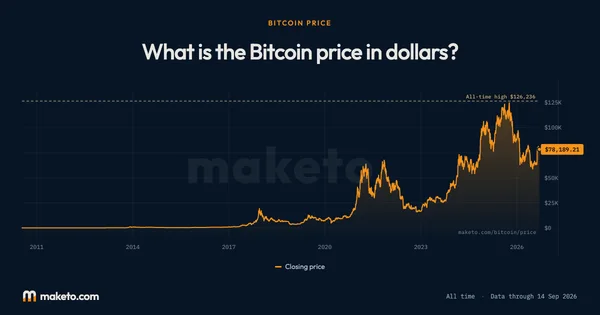
One Bitcoin
$69,491
Its average price for Aug 2026.
One US dollar
Buys 35% less than in Aug 2010
Aug 2010 is the first month on these charts. Based on how much US prices have risen since. For Aug 2026.
Everyday prices in sats
The average price in US cities each month, turned into sats at Bitcoin’s average price that month. A falling line means the item got cheaper in Bitcoin.
Everyday prices in dollars
The average price in US cities each month. A rising line means the item got more expensive in dollars.
Bitcoin’s price then, and in today’s dollars
Bitcoin’s average price each month, shown twice: as it was at the time, and adjusted for how much US prices have risen since, so every month is counted in the latest month’s dollars. The gap between the lines is how much buying power the dollar lost.
Understanding
Bitcoin Buying Power
A dozen eggs costs 3,269 sats ($2.27) in the US as of .
A gallon of gasoline costs 6,044 sats in the US as of .
A pound of ground beef costs 9,962 sats in the US as of .
One Bitcoin averaged $69,491 as of .
Measured from Aug 2010, a US dollar buys 35% less as of .
What is a sat?
A sat, short for satoshi, is the smallest unit of Bitcoin. One Bitcoin is 100 million sats, so the price of a dozen eggs reads as a few thousand sats rather than a string of zeros after a decimal point.
Why have these prices mostly fallen in sats but risen in dollars?
Over most of Bitcoin’s history its price has risen much faster than the price of groceries and fuel. So each sat bought more than it used to and the price in sats fell, while the same items have tended to cost more dollars over time. When Bitcoin’s price dropped, the price in sats climbed again, and the chart shows those stretches too. Past years say nothing about the next ones.
What does ‘in today’s dollars’ mean?
It restates every past Bitcoin price in the latest month’s dollars, using how much US prices have risen since, so a price from years ago can be compared fairly with one today. The gap between the two lines is how much the dollar itself lost over that time.
How is it worked out?
Each item’s price is the average price in US cities for the month, from the Bureau of Labor Statistics. To price it in sats, it is divided by Bitcoin’s average daily closing price that month and multiplied by 100 million, the number of sats in one Bitcoin. Bitcoin’s price in today’s dollars raises each past month’s price by how much the US consumer price index has risen since then.
What does it not tell you?
It follows three items, not everything a household buys, and US city prices, not what things cost where you live. It does not say where Bitcoin will move.
Sources and calculations
Maketo’s licence covers its chart design and calculations. Original figures keep their source terms.
Chart design and calculations: Maketo.
Source: U.S. Bureau of Labor Statistics.
Inputs to Maketo calculations. Version read on .
- US ground beef price per pound
- US price of a dozen eggs
- US gasoline price per gallon
- US consumer price index
BLS.gov cannot vouch for the data or analyses derived from these data after the data have been retrieved from BLS.gov.
Maketo made the calculations shown here from the published figures.