

Bitwise Chainlink ETF (CLNK) Flows
Is money moving into CLNK or out?
The money added to CLNK or taken out of it each trading day.
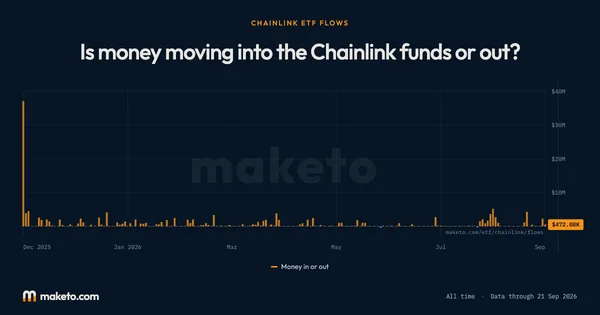
Money in or out of CLNK, each trading day
Each bar is one trading day. An orange bar is a day more money came into CLNK than left, a blue bar a day more left than came in. The biggest day for money coming in was $2.7 million, on Sep 23, 2026. One trading day in the record has no figure from the fund, so it has no bar.
Inspect and compare dates
Pick two dates to compare the money moving through CLNK on each.
| Measure | Change | ||
|---|---|---|---|
| Money in or out | $0 | $2.68M | +$2.68M |
RIGHT NOW
Over the past month, money has come into CLNK far faster than usual. Buying Heavily
The fund has taken in money 3 trading days in a row.
How much money has moved lately
Last trading day
Money in
Past week
Money in
Past month
Money in
0 days out, 6 days in
Is that fast or slow, for this fund
How much money has gone into CLNK, next to the other funds
Total money in
Everything invested in this fund since January 2026.
Share of all money in
Of everything that has flowed into the Chainlink ETFs since 2025.
All funds, past month
Money in
Moving with the pack. The funds as a group also saw money arrive this month.
How much of CLNK changes hands
Changed hands
What was bought and sold on 23 September 2026. Trading is not the same as money arriving.
That is 35% of the trading across the Chainlink funds that day.
What this means for you
Money is pouring into CLNK, faster than usual.
Over the past month about $8.5 million has flowed into CLNK, a heavier month of buying than 97% of its history.
Every dollar that comes in means the fund buys more Chainlink to back its shares. Heavy buying in a single fund usually means brokerage customers are picking this one specifically, through their advisors, retirement accounts, or trading apps.
Watch whether the pace holds, and whether the other funds are taking money in too. One fund alone can just be a few big customers moving; all of them together is real demand for Chainlink.
What to watch from here
- Heavy buying. About $8.5 million went into CLNK this past month, faster than 97% of its history.
- Whether the other funds are taking money in too. Together it's real demand, alone it's a fund story.
- Watch whether the pace holds or cools.
Understanding
Bitwise Chainlink ETF (CLNK) Flows
Where it stands today
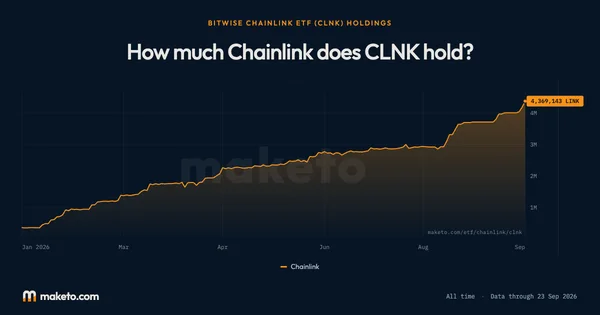
Bitwise Chainlink ETF (CLNK) has taken in $42 million since it launched as of .
$2.5 million worth of Bitwise Chainlink ETF (CLNK) changed hands as of .
Money in and out is the dollars people put into CLNK or took out of it. When more people buy new shares than cash theirs in, the fund takes in money and buys Chainlink with it. When more cash out, it pays them, and gives up coins to do it.
The Each day tab is one bar per trading day: orange when more money came in than went out, blue when more went out. The Running total adds every day up since January 2026, so it climbs while money arrives and falls while it leaves.
The reading at the top of this page judges the past month against CLNK's own history, so a fund that usually moves a little and one that usually moves a lot are each measured by their own yardstick.
The numbers
behind the chart
What does the current reading show?
Money in, running total: the latest reading is +$42M, on . The highest reading since is +$42M on ; the lowest is +$3M on .
Every dollar in and out of CLNK, added up day by day since January 2026. A day the fund did not trade carries the previous day's total.
What are the latest, highest and lowest readings?
| Measure | Latest | Highest | Lowest |
|---|---|---|---|
| Money in, running total | +$42M | +$42M | +$3M |
How do the readings compare with earlier dates?
| Reference date | Money in, running total |
|---|---|
| 1 month ago | +$33M |
| 3 months ago | +$25M |
| 6 months ago | +$16M |
What was the reading at each month’s end?
| Reading date | Money in, running total |
|---|---|
| +$34M | |
| +$26M | |
| +$25M | |
| +$23M | |
| +$20M | |
| +$16M | |
| +$11M | |
| +$6M |

Source: Money in and out is the fund's own daily record, read once a day. Reading for .