

TAKER FLOW
Which side would not wait for its price?
How much of each day's futures trading was bought at market and how much was sold at market, taking the price on offer rather than waiting for one.
Share bought at market across 11 exchanges
Recorded on 3 of the 10 exchanges we cover; the rest publish no reading of this kind. This reading has been complete since 2026-09-03; the 63 earlier days are not published, because a total that climbs as exchanges arrive is not a market move.
Right now
51.2% of it was selling at market
Trading at market means taking whatever price is on offer rather than waiting at a price of your own. The side that will not wait is the side paying for speed, which is the closest thing here to a measure of urgency. On this day that was $13.14 billion bought against $13.79 billion sold.
The numbers
behind the chart
What does the current reading show?
Share bought at market: the latest reading is 48.8%, on . The highest reading since is 52.7% on ; the lowest is 48.1% on .
A contract here is one exchange's version of the bet. The dollar-settled and the coin-settled versions count separately, so an exchange can carry more than one. Two sets of exchanges are published side by side and never spliced into one line: the widest set the site follows, and the three with the longest record. Joining them would draw a step change on the morning an exchange arrived and label it a market move.
What are the latest, highest and lowest readings?
| Measure | Latest | Highest | Lowest |
|---|---|---|---|
| Share bought at market | 48.8% | 52.7% | 48.1% |
Understanding
Bitcoin Futures Taker Buy and Sell Volume
Where it stands today
48.8% of futures traded at market was buying as of .
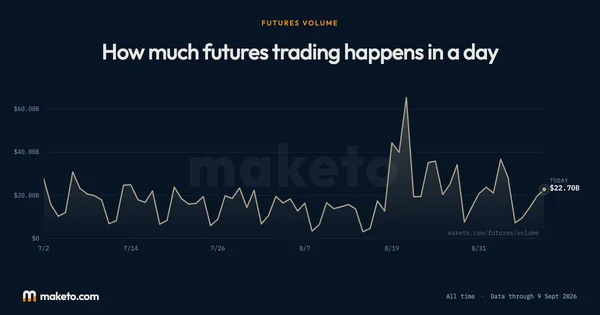
$13.14 billion was bought at market as of .
$13.79 billion was sold at market as of .
Trading at market means taking whatever price is on offer rather than waiting at a price of your own. Splitting a day's volume into what was bought at market and what was sold at market is the closest thing here to a measure of urgency, because the side that will not wait is the side paying for speed.
The share bought at market answers a different question from the long-short ratio. It says which side was unwilling to wait for its price during the day, rather than which side is sitting in a position at the end of it.
Only futures trading is counted here, and almost all of it is in perpetual contracts. Buying and selling at market on the spot market, where the coins themselves change hands, is a different record and is not added in.
It is not a forecast. A day when most trading was buying at market says who was in a hurry that day, not where the price goes after it.
Two views of the same number run side by side on this page and are never joined into one line. The wider one covers every exchange here and is the more complete picture; it is also the younger, because it only begins on the first day all of them reported. The narrower one is three exchanges with months of history behind it. A single line spliced from both would draw a step upward on the morning the other exchanges arrived and it would look exactly like a market move.
Source: Read from the exchanges' own published contract records, 11 of them, once a day. A contract here is one exchange's version of the bet. The dollar-settled and the coin-settled versions count separately, so an exchange can carry more than one. Reading for .